
Mastering Humidity Measurement: Key Insights for Improved Accuracy
Comparing the long-term performance of relative humidity measurement instruments involves much more than simply comparing their listed accuracy specifications. While accuracy specifications offer a good starting point, they don’t tell the whole story of an instrument's overall performance, particularly in real-world conditions over time. In this blog, we will go beyond accuracy specifications to uncover four critical factors you need to consider when selecting a relative humidity measurement instrument.
1. Definitions and differentiation

Accuracy is not the same as uncertainty but might be used as part of a technical specification. Accuracy is a qualitative term, but it can be defined using an expression of the uncertainty of a measurement.
For example, a pre-delivery calibration can “declare” the quoted specification or accuracy of an instrument.
Accuracy as stated in the Rotronic technical specification refers to the maximum difference between a measurement value taken by a reference instrument and that given by an IUT (Instrument Under Test) which is known as measurement error.
Measurement uncertainty of a calibration is defined as the range in which the “true value” is expected to lie. For example, an IUT (Instrument Under Test) at a reference value of 35.0 % rh might read 34.8 % rh with an uncertainty of ± 0.4 % rh. This means that the true value is expected to lie in the range 34.4 %rh to 35.2 %rh.
Tolerance is used in the Rotronic technical specification as a limit maximum permissible measurement error and it is not the same as measurement uncertainty Therefore, the uncertainty of a measurement is needed additional to allow to decide if an application specification is met.
Specification is not the same as uncertainty. A specification lets a customer know what kind of performance can reasonably be expected from a given product in each range of operation. The maximum permissible measurement error and the measurement uncertainty should be considered.
2. Classification of Errors in capacitive humidity measurement
Temperature and Pressure Dependency
The relative humidity depends on temperature and pressure.
Rotronic HygroClip probes automatically compensate for the physical temperature dependence. The advanced electronics include saturation vapor pressure tables similar based on the standards of WMO to allow for the accurate corrections.
The total gas pressure is usually not considered in common relative humidity measurements. An exception is when there is a big pressure difference eg of several bar. For example, relative humidity measurements on the outlet of a pressure or vacuum chamber will provide different readings to the actual relative humidity inside the chamber due to the impact of pressure changes.
Rotronic HygroClip probes can be programmed with different pressure to allow for improved compensation especially when outputting calculated values like dew point.
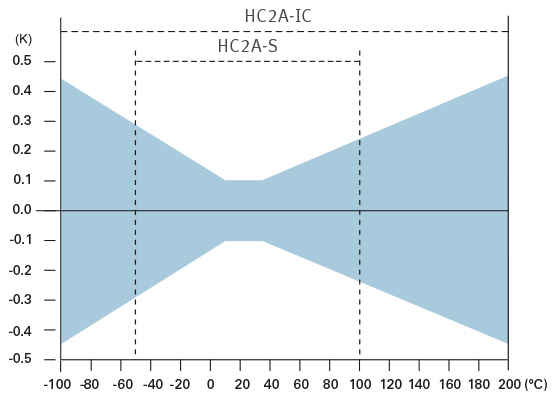
Temperature Errors
Temperature can have a major effect on several aspects humidity measurement. The components of all electronics can be affected by temperature changes. Additionally, the capacitive humidity sensor has hygroscopic properties vary with temperature. Also, the accuracy of the temperature sensor itself, which is also used to compensate has an impact to the accuracy of humidity measurement
HygroClip – Humidity sensor temperature compensation
All relative humidity sensors requires compensation for the effect of temperature on the humidity output signal to maintain accurate measurements over a wide range of temperature conditions. The AirChip 3000 inside the Rotronic Hycroclip probe holds a set of 31 tables in memory corresponding to temperature values within the range of -100 °C to +200 ˚C. Each table holds compensation data between 0 % rh and 100 % rh in steps of 10 % rh. Combined with high accuracy temperature measurement, very low power, and therefore low self-heating design and advanced electronics, the Rotronic HygroClip can achieve exceptionally accurate relative humidity and temperature measurements across a broad range of temperatures.
Linearity Errors
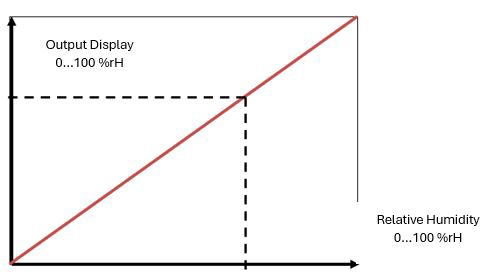
The ideal sensor is totally linear in terms of humidity vs it output (see Pic. 2) but the typical response of a relative humidity sensor (between 0…100 % rh) is non-linear. Depending on the effectiveness of the correction made by the electronic circuits, the instrument may have a linearity error. If both the sensor and associated electronics have reproducible characteristics, the linearity error is a systematic error.
The capacitance of the humidity sensor used in conjunction with the AirChip3000 is a non-linear function of relative humidity (% rh). The AirChip3000 changes the raw values read from the humidity sensor to linear values and compensates these values for the effect of temperature on the humidity sensor and unique compensation values for each probe.
HygroClip-Humidity Sensor Linearization
Every HygroClip Probe has an inbuilt microcontroller called AirChip3000, which keeps in memory a set of two tables (A1 % and A2 %) consisting of corrections (linearization) to be applied to the raw humidity data generated by the humidity sensor. Each table holds 101 values (from 0 to 100 % rh, in steps of 1 % rh) to achieve a very precise linearization of the humidity sensor. Table A1 % holds the factory default values. Table A2 % holds the additional corrections generated during adjustments made by the user. The linearized humidity value is obtained by adding to the raw humidity value the corresponding corrective values from both tables. An interpolation is used for intermediate raw values. Users can reset the AirChip3000 to its original factory settings at any time.
Attention:
Careless selection of the adjustment values can result in a different distribution of the linearity error and can be detrimental to instrument accuracy
Generally, the values recommended by the instrument manufacturer for adjustment are determined with the goal of minimizing the linearity error. Adjustment at those values should reduce linearity error.
Recommendation Rotronic for adjustment points:
A 3-point adjustment for humidity and temperature measurements ensures precise sensor performance across different environmental conditions.
- First Adjustment Point at 23 °C and 35 %rh: This standard adjustment point is used to improve the baseline accuracy of the sensor under typical ambient conditions. Adjustment at this point helps ensure reliable measurements in moderate environments.
- Second Adjustment Point at 23 °C and above eg 50 %rh -80 %rh: Adjustment point at a higher humidity level, such as 80 % relative humidity, improves the sensor's ability to measure accurately in higher humid conditions. This step is crucial for validating performance where moisture levels are elevated, ensuring that the sensor remains accurate across its operational range.
- Third Adjustment Point at 23 °C and below eg 10 %rh -20 %rh: This low humidity adjustment point improves the sensor's performance in drier conditions. Adjustment at below 20 % rh is essential for confirming that the sensor can detect and report precise data even in environments with minimal moisture.
By using these three different points, the adjustment ensures that the sensor's overall accuracy is optimized and maintaining tolerance levels across a wide humidity spectrum.
Adjustment Error
Calibration consists of comparing the output of a measurement instrument against a reference and reporting the results. Adjustment consists of changing the output of an instrument and calibrating it to match the output of the reference.
The reference instruments used to provide known humidity and temperature values for calibration have their own uncertainty made up from accuracy, repeatability, reproducibility and hysteresis values, which must be taken into consideration when specifying final instrument uncertainty. In addition, if no adjustment is done during a calibration service, the measurement error must be considered and included in the calculation of instrument result or added to the accuracy as an uncorrected error.
Adjustment with Rotronic Humidity Standards
Temperature has an impact to the equilibrium humidity of Rotronic humidity standards, the difference between the calibration value at 23 °C from the certificate and the humidity value of actual temperature from the table must be added manually to the input of adjustment reference value.
Hysteresis
Hysteresis is the maximum difference that can be measured between corresponding pairs of data, obtained by running an ascending and a descending sequence of humidity conditions. Hysteresis determines the reproducibility of a humidity instrument.
For any given instrument, the value of hysteresis depends on several things:
- The total span of the humidity cycle used to measure hysteresis
- Exposure time of the sensor to each humidity condition
- Temperature stability during the measurement
- Criteria used to determine sensor equilibrium and previous sensor history
Usually, sensor hysteresis increases as the sensor is exposed to high humidity and high temperature over longer periods of time.
Attention:
Temperature can change the capacitance of the sensor and the cable. Humidity values reported by the electronics must compensate for the impact of temperature on the probe
It’s only meaningful to state a sensor’s hysteresis values while also providing details on how the tests were performed. In actual measurement practice, conditions are extremely diverse and hysteresis may or may not reach its maximum value. Therefore, it is reasonable to consider hysteresis a random value that can be neither fully predicted nor compensated. When the accuracy of an instrument is specified, half the maximum value of hysteresis should be equally distributed as a positive and a negative error. However, instrument reproducibility should not be specified at less than the full value of hysteresis
3. Understanding humidity accuracy
Accuracy, when referring to measurement instruments, typically means the closeness of agreement between a measured quantity value and a true quantity value. However, in practice, it’s essential to remember that there's no such thing as a “true” value — every measurement comes with some degree of measurement uncertainty and a measurement error. The accuracy specification on a Rotronic datasheet simply describes the allowable difference between the readings from your instrument and a reference device (measurement error).

In many cases, the accuracy specification on its own is insufficient for evaluating the long-term reliability of a humidity sensor, especially if you are working in environments with variable conditions. Here’s why:
- The Rotronic accuracy specification includes no factors as hysteresis, repeatability, linearity, long-term-stability and measurement uncertainty.
4. Accuracy variations over temperature ranges
Most accuracy specifications are only valid at a particular temperature or within a narrow temperature range, such as ±0.8 % rh at 23 °C or within a 20 °C ± 5 °C range. If you use the instrument outside of these parameters, its accuracy will likely degrade. This is because relative humidity probes are temperature-sensitive, and their performance is affected by changes in ambient temperature.

What to watch for:
- Temperature sensitivity: Many relative humidity probes will see their accuracy decrease as the temperature deviates from the calibration temperature. This is especially important in industries like environmental chambers or process control systems, where temperatures vary significantly.
5. Calibration measurement uncertainty: A critical factor
Every measurement, no matter how precise, carries some uncertainty. Even measurements from national metrology institutes such as NIST (National Institute of Standards and Technology) come with an uncertainty figure. Calibration uncertainty refers to the precision of the calibration procedure and is a key piece of information for understanding the total accuracy of a humidity instrument.
6. Long-term drift (stability): The hidden challenge
All relative humidity measurement instruments experience some long-term drift — a change in readings over time due to factors like aging of electronic components, mechanical wear and contamination buildup. Capacitive relative humidity sensors are vulnerable to drift because they are exposed to the environment they’re measuring. An ageing of the polymer in the humidity senso is a normal behavior, it shows typically a higher value as higher the humidity condition is.
When a drift of more than 3 % rh is exceeded, Rotronic recommends replacing the sensor, because the sensor then drifts faster and faster.
Common causes of drift:- Aging of electronic components
- Mechanical degradation of materials
- Contaminants like dust, particles, or chemical vapors
Long-term drift can be predictable or unpredictable, depending on the sensor's design and the environment. While temperature sensors can often be sealed to avoid exposure to contaminants, relative humidity sensors are typically "air-breathers," making them more susceptible to environmental influences.

7. Handling contaminants: Particulates and vapors
RH sensors are particularly sensitive to contaminants in the environment. These contaminants can affect readings temporarily or permanently, depending on their type and concentration. The two most common types of contaminants are:
- Particulate contaminants, such as dust or salts, can accumulate on the sensor and affect its readings. In most cases, particulate matter slows down the response time or generates measurement deviations at a specific humidity (depending on the salt type), due to a microclimate on the sensor.
- Vapor contaminants, such as volatile organic compounds (VOCs), can cause sensor readings to drift, particularly in closed systems like environmental chambers This contamination typically causes a lower reading as the VOCs block the water molecules from entering the sensor.
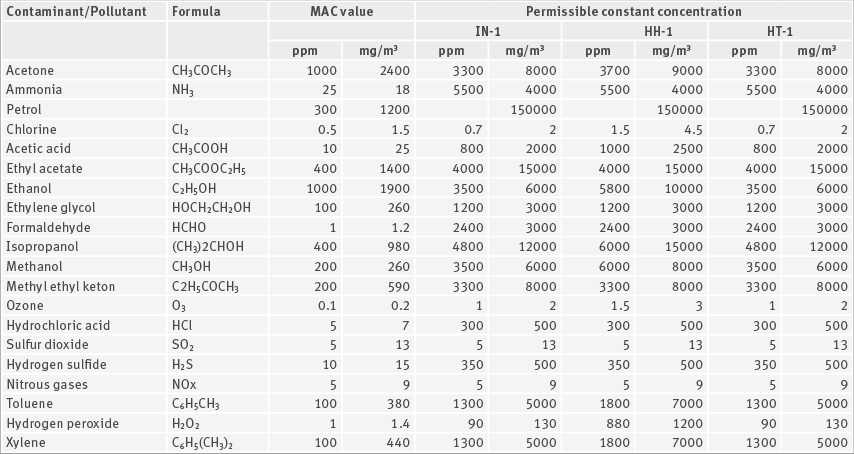
Selecting the right protective filters and regular cleaning can help reduce the impact of particulate contaminants, but vapor contaminants are much harder to filter.
In harsh environments, shortening calibration and adjustment cycles can help maintain accuracy, because a higher yearly drift is expected.

Conclusion: Look beyond the accuracy specification
Choosing the right relative humidity measurement instrument requires more than just looking at the accuracy specification on a datasheet. Factors like temperature range, calibration uncertainty, long-term drift, and environmental contaminants all play crucial roles in determining the true long-term performance of your device. To avoid out-of-tolerance conditions, dive deeper into product data, talk to manufacturers, and align the specifications with your specific use case and ensure you use best practice in your instrument installation, maintenance and calibration.
Contact Us
Reach out to PST for more information on our products and how we can assist with your humidity measurement needs.
Related Content
Humidity Measurement & Monitoring Relative HumidityDefine the Right Humidity Probe for Industrial Applications
Relative Humidity Calculator
Humidity Handbook


Want to see more information like this?
Sign up to one of our Industry newsletters and you’ll receive our most-recent related news and insights all directly to your inbox!
Sign Up